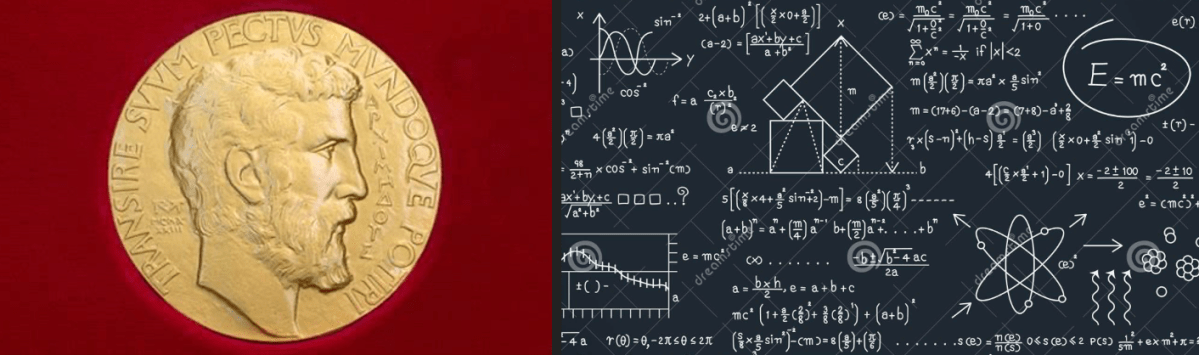
Here are some seriously smart people
When I was teaching my doctoral seminar, I often mused what would the state’s legislators think if they ever heard one of my lectures. Somehow a lecture on the real effects of monetary shocks in sticky price models or a sufficient statistic approach to optimal financial institution regulation might lead to a discussion as to whether the taxpayer’s money is being wasted paying my salary and whether my tenure should be revoked. I remember a lecture while in graduate school at Ohio State by the famed Norwegian economist Karl Borch who was a pioneer in the economics of uncertainty and whose highly mathematical work derived testable implications from the abstract model of general equilibrium with markets for contingent claims. In this way, he brought economic theory to bear on insurance problems. To illustrate a point he put an example on the board, drew a map and wrote “Columbus to Pittsburg”. I raised my hand and he seemed relieved that someone would ask a question and I said “Isn’t there an “h” in “Pittsburg”? That became known as the Harold Black question.
What would our legislators think of the winners of the Fields medal in mathematics? Like many of the disciplines where young practitioners are honored, the Fields Medal goes to the top mathematicians under the age of 40. This year’s winners are Yu Deng of the University of Chicago, John Pardon of Stony Brook University, Jacob Tsimerman of the University of Toronto and Hong Wang of New York University.
Deng studies huge systems with billions or trillions of objects where it is impossible to calculate the precise interactions among them. So mathematicians use statistical equations to model collective behavior. Deng worked to derive one of those statistical models from Newton’s laws. It’s called the Boltzmann equation which can be expressed in terms of a probability density function 

Pardon works at the intersection of geometry (rigid shapes) and topology – (bendy shapes). He has focused specifically on the nature of knots, which you can think of as tangled loops of rope that can only be untangled by cutting the rope. Can all knots, no matter how tangled, fit within a certain measure of how bendy the rope is? Pardon proved that they can not (knot?). https://www.math.stonybrook.edu/~jpardon/manuscripts/20_nonlinear.pdf
Tsimerman helped prove the André-Oort conjecture, a longstanding problem in geometry, which helps describe higher-dimension objects called “Shimura varieties.” Those shapes are closely connected with “Diophantine equations” which is a polynomial equation with integer coefficients, for which only integer solutions are of interest. Tsimerman is working in artificial intelligence where I bet the pay is higher than in his math department. Here is one of his papers on AI. https://arxiv.org/pdf/2507.09369
Wang worked on a problem called the Kakeya conjecture, which ponders a set of needles pointing in all possible directions. You can’t change where needles point, but you can slide them around – a decades-old geometric problem that addresses the shape left behind by a needle moving in multiple directions. https://arxiv.org/pdf/2502.17655
Both Deng and Wang attended Peking University before earning doctorates in the U.S., Deng from Princeton and Wang from MIT. Tsimerman is a Russian born Canadian with a Princeton PhD. Pardon is from Chapel Hill, NC, a Princeton undergraduate and Stanford PhD. What does this say about the mathematics department at Princeton?
Congratulations to all.


Today is an example of why people read this blog. Even if all I did would be to repeat the topic- I’d sure sound smart..
My wife flew to France for a wedding. I was shocked when I flight-tracked her to the south of Greenland , then North of Ireland.
A family of pilots tells me this is the shortest route. They talk to me about 2 strings, placed on a globe- and how the Northern route is the shortest, closer to the equator = the longer string..
And I’m told to stop using the example that I’m standing perpendicular to the earth. with the Atlantic is a high mountain range.., too high to fly over..
The wife had no idea of the route. Fm the sky it all looks the same..
I don’t know if this route involved a genius or dreamer , was a crude hypothesis , but ultimately somebody had to test the hypothesis.. And now my wife can go to France…
Thanks to Dr. Black, that today’s blog would lead to Wolff’s Hairbrush example and exploration leads to Kakeya’s plain brush , then ‘QuantumSUNDAYS’.
“ So…..A needle shadows the world” is not the start of a joke.
LikeLike
I love this comment!
LikeLiked by 1 person