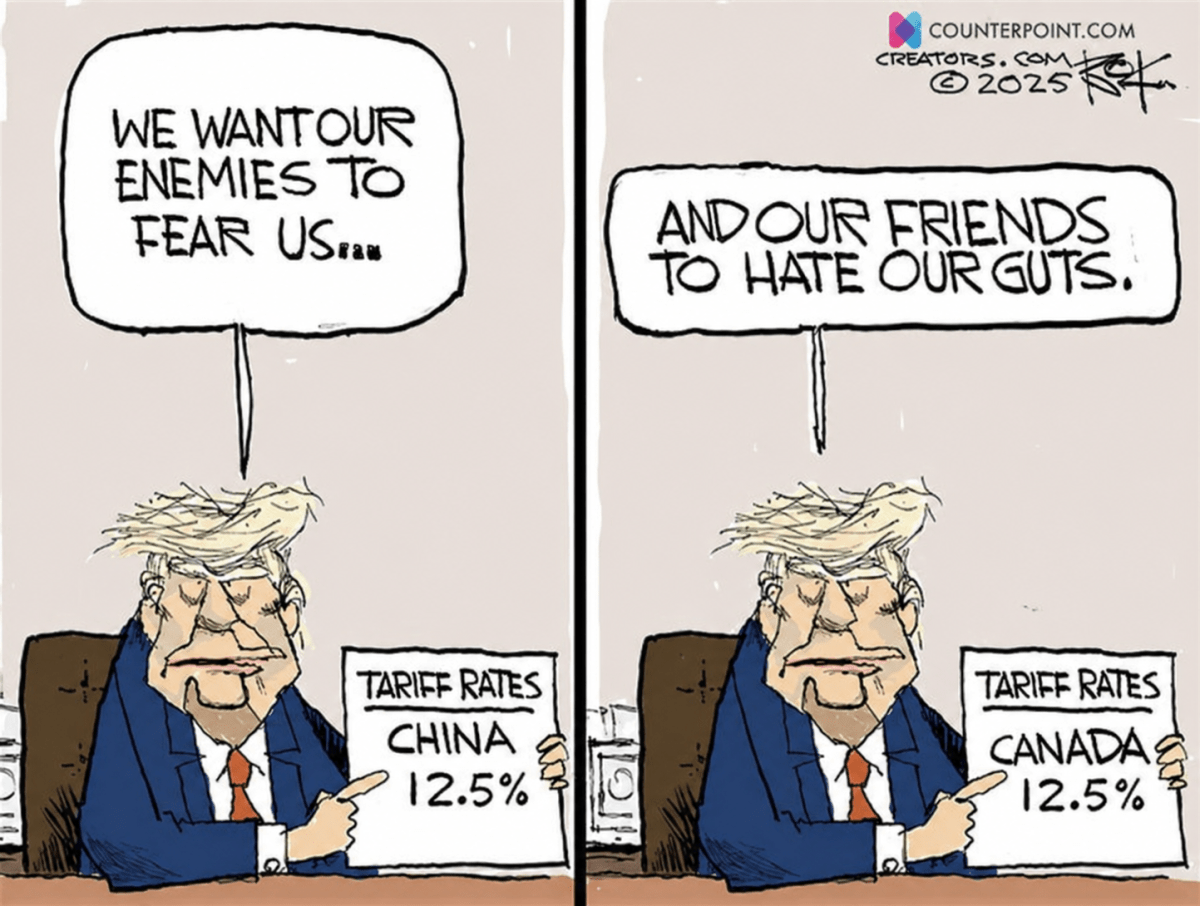
Trump’s latest tariffs
In his continuing effort to find a way to make his illegal tariffs legal, the president – or more likely his anti-trade trade representative Jamieson Greer – has come up with another effort that is almost comical. It is use of Section 301 of the Trade Act of 1974. Greer is accusing 60 of our trading partners of failing to enforce laws around “forced labor,” using that as a justification to impose tariffs of 10 percent to 12.5 percent. The tariffs affect 99% of imports to the United States. This is another attempt to reimpose Trump’s universal tariffs. The man just doesn’t give up. This attempt is so childish that I was going to write a rejoinder. But my friend Professor Don Boudreaux of George Mason University beat me to it. If you are familiar with Don’s blog, Café Hayek you know that the vast majority of his posts are regarding tariffs. Because of that I have written less and less about them and just refer you to Café Hayek to see the continuing debunking of the president’s obsession.
Here is an article in the Wall Street Journal
Here Don is responding to a similar piece in the Washington Post.
Editor:
The Trump administration’s latest excuse – of which you’re wisely skeptical – for imposing, this time under Section 301, broad punitive taxes (a.k.a. tariffs) on Americans’ purchases of imports is that it wishes to combat forced labor (“Trump tries a new trick to raise tariffs,”June 4).
Every civilized person sympathizes with prohibitions on the sale and purchase of goods produced by slaves. Yet every such person als0 understands that protectionists have incentives to abuse this sympathy by exaggerating the extent to which the stream of commerce contains slave-produced goods. In this light, here are some relevant facts (gathered with the help of Claude).
In China, which is the trading partner accused as being most reliant on forced labor, the upper estimate of the number of forced laborers is 3.17 million. Now looking at other data from 2024 – and making assumptions as generous as possible to the administration’s case – we have these additional facts:
– Total number of manufacturing workers in China: 120 million
– Annual U.S. imports of manufactured goods from China (including estimates of transshipments): $542 billion
Even if (contrary to fact) all forced-labor workers in China work in manufacturing, that means that 2.6 percent of China’s manufacturing workers are forced laborers. Assuming (also almost certainly contrary to fact) that the productivity of these workers is as high as that of China’s non-forced-labor manufacturing workers ($39,000 per worker), the value of U.S. manufactured-goods imports from China that is produced by forced labor is likely around $14.1B. With total U.S. imports of manufactured goods being $2.71 trillion, the maximum share of U.S. manufactured-goods imports that is produced by Chinese forced labor is 0.5 percent.
As a portion of total annual U.S. production of manufacturing output – $7.1 trillion – U.S. imports of forced-labor manufactured goods from China are a paltry 0.2 percent.
These numbers strongly suggest that the effects on America’s economy of forced labor in China are too minuscule to meet Section 301’s requirement that the challenged actions be shown to burden or restrict U.S. commerce. You are indeed wise to doubt the sincerity of the administration’s latest excuse for obstructing Americans’ freedom to trade, as a far worse source of such burdens and restrictions is the administration itself.
Sincerely,
Donald J. Boudreaux
Professor of Economics
and
Martha and Nelson Getchell Chair for the Study of Free Market Capitalism at the
Mercatus Center
George Mason University
Fairfax, VA 22030
 haroldblackphd.com
Anti-Forced labor tariffs with China trade should discuss industrial / agricultural ‘utilization’ of disregarded ethnic groups. This has resulted in tracing the source of cotton by Auditors of high priced fashions.
Tariffs today as a moral statement would have to be involved in so many layers…
I was so angry at trying to buy Christmas gifts not made by Communists. I could not find any American-made item in a Coca-Cola gift shop..
Coke is America’s global claim to fame . If we don’t buy those China-made fountain drink glasses holding a Coke-smelling candle- what is a Chinaman to do with an item only created for sale?..
…”the shortcomings of tariffs became evident in McKinley’s time and began to forge a free-trade consensus that eventually pushed tariffs out of vogue for nearly a century — basically until Trump arrived on the scene…” Yahoo/Finance…
OUR TIMES, 1926 : …”. President McKinley made a plea for reciprocity which became a disputed point of Republican party doctrine for years:
.”.. “Commercial competitors we are, commercial enemies we must not be…. Isolation is no longer possible. … We must not repose in fancied security that we can forever sell everything and buy little or nothing. . • : Reciprocity is the natural growth of our of our wonderful industrial development…
… “The period of exclusiveness is past. Reciprocity treaties are in harmony with the spirit of the times; measures of retaliation are not. If perchance some of our tariffs are no longer needed for revenue, or to encourage and protect our industries at home, why should they not be employed to extend and promote our markets abroad?.””.
LikeLike
You should be writing the blog. There are no good reasons in economics for tariffs.
LikeLiked by 1 person
Thank you.
LikeLike
It’s almost as if Trump we’re trying to lose the midterms on purpose.
Why can these idiots not see tariffs for the taxes they are, borne eventually by the consumer through increased prices? How much more can the American consumer bear? More importantly, how much WILL they bear?
LikeLike
This is the ultimate middle finger to the American voter. I really don’t think Trump really cares about the adverse consequences. He certainly is going to get no contrary advice from his cadre of yes men.
LikeLike