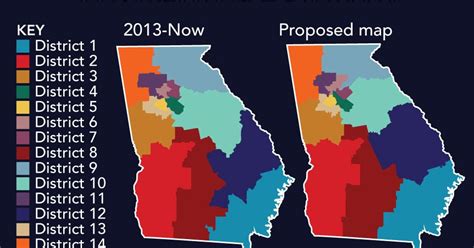
Georgia Drops Its Proposed Racial Gerrymander – for now
In Georgia on June 17, republican leaders in the state legislature abruptly decided to shelve a proposal that would have redrawn two of the state’s four congressional districts represented by black members of Congress. The proposal also included changes to state legislative districts that would have reduced the number of majority-black State House districts from 54 to 37 and majority-black State Senate districts from 17 to 9.
Currently, democrats hold 80 seats in the state House, 75 are held by black legislators, while republicans hold 99 seats. In the state Senate, democrats hold 22 seats,12 by black legislators, compared to 33 for the republicans.
Not surprisingly, the proposal sparked a strong backlash from the black elected officials and civil rights activists. Hundreds of demonstrators gathered at the state capitol, chanting, “Black voters matter!” and “You can gerrymander a map, but not a movement!” Amid the growing controversy, state House Speaker Jon Burns announced that legislators would not consider redistricting during the current session.
The decision was driven more by political calculation than by a sudden change of heart. Republicans fear that pursuing the redistricting plan would energize democratic voters—particularly black voters—and increase their turnout in this year’s elections. But they may be energized none the less with former Atlanta mayor Keisha Lance Bottoms being the democrat nominee for governor. Her opponent is businessman Rick Jackson who spent $50 million of his own money in his race against the state’s lieutenant governor, Burt Jones. But the primary concern of the state’s republicans and national republicans too is to defeat the incumbent democrat senator Jon Ossoff by republican Congressman Mike Collins.
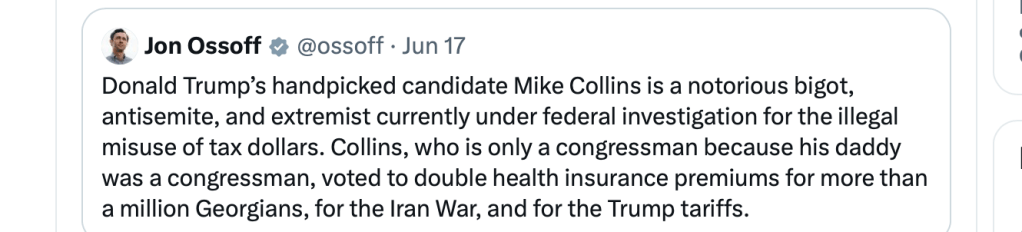
The Ossoff-Collins contest will have the nation’s attention and has already become highly contentious. Ossoff quickly launched attacks on Collins saying of Collins “His rich daddy, a former congressman and career politician himself, handed Mike the keys to a company with dozens of employees, making multimillionaire Mike richer while real truckers did the actual work. Maybe that’s why Trump likes him so much.” Ossoff himself tweeted calling Collins a bigot, an antisemite and a crook.
Collins shot back in an ad, “Ossoff voted with Biden 98% of the time. The deciding vote for Biden’s inflation disaster. Higher taxes on gas and groceries. Crazy far-left bills to let men compete in girl sports. No wonder California crazies gave him three times as much money as the entire state of Georgia.” Note however that Collins did not call Ossoff the “S” word.
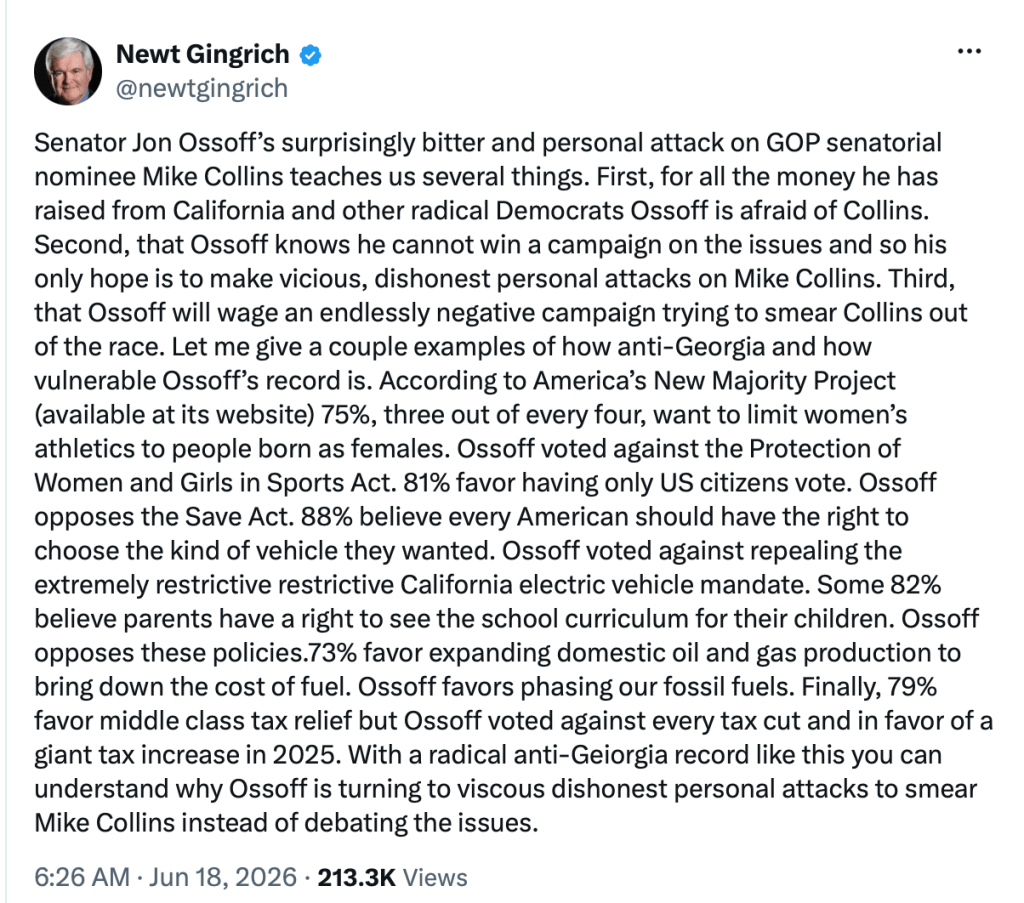
Also Newt Gingrich chimed in
Collins also calls Ossoff, the beneficiary of family wealth, a “trust-fund socialist” who has never held a real job.
Ossoff admits there are some advantages he received from his upbringing:
“I openly acknowledge that the opportunity I’ve had is a function of my parents’ hard work … the opportunity to get a great education without debt, the opportunity to do what I love and pursue my passion, which is confronting and exposing injustice and the abuse of power.”
But one must question Ossoff’s accusations of antisemitism. Whereas his fellow Georgia senator Raphael Warnock has said of Maine’s Graham Platner “These allegations are deeply concerning. And I think the people of Maine deserve answers. And this kind of abuse is something to be taken very, very seriously.” Ossoff is Jewish and has been noticeably quiet on the antisemitism in his own party. A republican official said “Graham Platner is rotten to the core and Jon Ossoff must immediately disavow him. Anything less is an endorsement of Platner and his disgusting comments.” I am certain this will be brought up over and over again during the campaign.
Financially, Ossoff enters the race with a substantial advantage. He has raised more than $31 million, much of it from out-of-state donors, compared with approximately $3.5 million raised by Collins. But the GOP-aligned Senate Leadership Fund is planning to spend $44 million investment in support of Collins in what will likely be the most expensive Senate race of 2026.
All indications suggest that Georgia voters are headed for a lively and hard-fought political season both in the governor’s race and especially in the Senate—alongside the state’s traditional fall passions of football and deer hunting.


Just requesting more thought on the South Korean factor around the Atlanta area. Not in reference to that construction, raided to capture So. Korean ‘illegal’ workers.
I found a South Korean game show video tape. Didn’t understand it, but the mechanics was fascinating to watch. I was even more shocked to find it was produced in Georgia..
South Koreans have American podcasts in their own language- with one English-language episode on moving in to section 8 housing- “ live for free”.
Antisemitism and Platner popping up In GA: Jewish also includes Jews who don’t want the Orthodoxy, or Jewish legalism. Or want to go to Israel. I know a Jew who prefers pilgrimage to Vatican City.
Jews also reject Judaism. Don’t know how Ossoff feels about his culture, but I’m not impressed with Gentiles arguing Judaism.
Sorry Newt, but my aforementioned factory was to bring GA into competition with TN, on the rejection of fossil fuels, creating a GEORGIA battery-factory , for electric cars.
LikeLike