Blog

A Real Ceasefire? Or Just Another Cease farce?

A Real Ceasefire? Or Just Another Cease farce?

So we have a “ceasefire” with Iran. Previous “ceasefires” were more like cease farces with occasional attacks on our Gulf allies, the US firing on a ship and killing three Indian sailors, a few Iranian missiles lobbed at Israel with Israeli continuing operations in southern Lebanon against Hezbollah. Trump reportedly had a heated argument with Netanyahu telling him to stand down but in more colorful language. We don’t know what Netanyahu said back, but Israel’s Defense Minister Israel Katz told Trump to pound sand— the Israelis will stay in Lebanon “without any time limit” and will clear the Lebanese population from the areas it holds. So much for that.

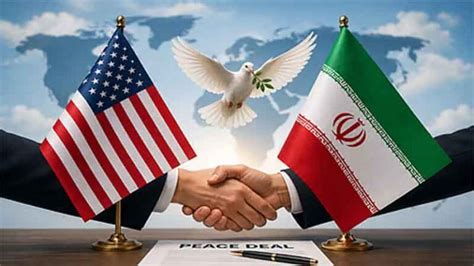
Now comes a bilateral agreement between the US and Iran that leaves Israel out entirely. Of course the Iranians were never going to sit at the same table with the Israelis making the United States serve as Israel’s de facto proxy.  For the agreement to hold, Israel would presumably have to accept its terms. Yet that raises an equally difficult question: would Israel be expected to withdraw from southern Lebanon, leaving Hezbollah’s military infrastructure intact and the security of northern Israel compromised threatening the lives of thousands of Israelis?

We don’t know the full terms. What we do know is that Iran will reopen the Strait of Hormuz and we will lift our blockade. Trump, never one to miss a moment, went full NASCAR on us: “Ships of the World, start your engines. Let the oil flow!” There are reports that the US will also release some of Iran’s frozen assets — which is interesting, given how loudly Trump criticized Obama for doing the exact same thing in his “peace” agreement. And let’s be clear about what this actually is: a 60-day truce, during which the two sides will try to hammer out a final deal. Where have we heard that before?

Iran has broken every agreement it’s ever made. You’d have to be an optimist to think this one will be any different. That said, there is one small reason not to be completely pessimistic. Iran’s military has been seriously degraded – even though they do seem to have an unlimited supply of missiles and drones. Breaking the agreement would likely cause Trump to go full UFC and really try to bomb them into oblivion – a prospect the Iranian leadership would be unwise to dismiss.

Whether Israel convinced Trump to enter the United States into the conflict remains a matter of debate. What is less debatable is whether Trump’s stated objectives have been achieved. Is Israel safer now that Iran’s military has been severely diminished? What about the nuclear threat and Iran’s capability of delivering warheads to Europe? Trump said that he was going to war with Iran to accomplish three goals: the destruction of Iran’s ability to wage war; stopping its nuclear weapons program; regime change and the liberation of its people. So when the final deal is signed – if it is signed at all – will any of these goals be accomplished? 

On the military side, Iran has been weakened militarily, which is good news for its Gulf neighbors. On nukes, Iran has always insisted its program was purely civilian and not military. Almost nobody believed them. Whether the program gets fully dismantled and whether Iran will accept real inspections, are still open questions. And regime change? Forget it. Regime change is not part of the agreement. In fact, when the ceasefire was announced, many Iranians took to the streets in protest — not against the government, but against the deal. Crowds chanted “death to the compromiser” – Foreign Minister Abbas Araghchi – who was called on to resign. A member of the Iranian parliament Mahmoud Nabavian called the agreement a “total loss.” Back here at home, I’d bet Tucker Carlson, Lindsey Graham and other war hawks are equally unhappy, pushing for the war to keep going until the Iranian government actually falls.

So does Trump get anything out of this? The Iranians have played seven US presidents and Trump has been no exception. The TACO label — “Trump Always Chickens Out” — has been following him around for a reason. His latest reversal came when he threatened to bomb and occupy Kharg Island to shut down Iran’s oil supply entirely, then backed off at the last minute claiming that more fruitful discussions were underway. A friend of mine said that threats are the only thing the Iranian regime understands, which is why Trump does what he does. Maybe. But couldn’t he make those threats quietly, instead of publicly, looking like he’s constantly backing down making him seen like a wuss?

It looks like Trump wanted one thing above everything else, to get the Strait of Hormuz open. And he got it. I suggested early on that if Iran just offered to rename it the Strait of Trump, this whole thing would have been over much sooner. But the broader problem hasn’t gone away. Iran will find a way to eventually get a nuclear weapon. I wonder why they haven’t just bought one or two from North Korea? And if Trump can’t get Israel to stop fighting Hezbollah in Lebanon, how does the deal survive? Iran seems to consider Hezbollah a core strategic asset and will defend it — and its foothold in southern Lebanon — no matter what.

At a minimum, here’s what Trump should have demanded: no highly enriched uranium, with real inspections to back it up; limits on how much Iran can rebuild its military; a guaranteed open Strait of Hormuz; and an end to Iran’s support for its proxies — Hamas, Hezbollah, and the Houthis. After World War II, both Germany and Japan were forced to cap their military capabilities. The same standard should apply to Iran. And it should be made crystal clear: violate any term of the final agreement, and the bombing starts again — this time for real and no TACO.


Three-handed Libs. A Tariff Exception and why Blanche as AG Is a Losing Bet

Three-handed Libs. A Tariff Exception and why Blanche as AG Is a Losing Bet

Believe Only Liberal Women

A photo of Maine’s Graham Platner showed him surrounded entirely by women. Around the same time, a news article reported that Maine women were deeply conflicted about the Senate race—torn between voting for Platner, who faces allegations of abusing women, sending explicit texts, and subscribing to a website associated with pedophilia, or voting for incumbent Susan Collins. They say the conundrum is Collins’ vote for Bret Kavanaugh. If this is the case, then I have seen no better argument than taking away the vote from these women. 

One woman put it plainly: “This is a very painful choice for a lot of women. One choice is to vote for somebody who I simply don’t think has the experience, the character, or even the political orientation that I find valuable”—referring to Platner. She added that Collins’s Kavanaugh vote “was disappointing, and it has been devastating for women.” Another woman tried to excuse Platner‘s behavior: “Given his background, his time in the Marines, his PTSD, I can see him as a flawed candidate. I’m not saying he’s perfect, but I generally vote on policy.”

The underlying excuse of Collins’ vote for Kavanaugh and Kavanaugh’s vote on Roe v. Wade—is an obvious canard. Approximately 70% of Maine women support abortion access in all cases. Collins, notably, also supports abortion rights and has voted to confirm every liberal woman currently serving on the Supreme Court. Collins also sponsored a bill to codify abortion rights. But apparently that is not good enough for the women of Maine who should be honest and admit that Collins’ vote was immaterial. They would vote against Collins even had she voted against Kavanaugh because she has an “R” attached to her name.

Remember Christine Plasey Ford who suddenly materialized to accuse Kavanaugh of sexual assault when they were in high school? There was zero corroboration for her allegation. No high school classmate materialized to vouch for Ford. On this basis, Collins voted for Kavanaugh and showed her political courage because even if she had voted against him, he still would have been approved by the senate. I wonder what excuse would the Maine women use had she voted against Kavanaugh? Because it is Trump they are after and Collins is standing in their way. It reminds me of what Trump once said “In the end, they’re not coming after me. They’re coming after you — and I’m just standing in their way.”

What struck me at the time was that the Democrats, for all their effort, could not produce a single classmate willing to corroborate Blasey Ford. Nevertheless, the party was firmly in its “believe all women” mode. Elizabeth Warren was outraged that Republicans pressed forward with their support despite the accusations. Now, with far more corroboration against Platner than ever existed against Kavanaugh, Warren is out on the trail for him, declaring, “He’s my man.” Good grief.

Senator Sheldon Whitehouse (D-RI) was among the most vocal during the Kavanaugh hearings: “Today I stand with women who are brave enough to come forward with their stories of abuse and mistreatment. They deserve to be heard and credible allegations must be investigated. We must believe survivors, not bully them.”

That was then. What about now? Whitehouse supports Platner and describes the multiple women’s allegations as “a lot of nothing.” “I mean, the only one who had anything to say that seemed unsettling’ was a woman who works for

right-wing political operations.” It matters little that at one Platner accuser provided corroboration. Translation: “believe only those women that the democrats can dredge up.”

To be fair, not all of Maine’s women have abandoned their principles. One voter put it: “I’m a Democrat, so I want Democrats to win. But I also care how we win. And our argument can’t be that character only matters when it’s candidates from the other party.” It’s a shame that many of Maine’s other women and the entire democrat establishment (except for John Fetterman) have no principles. I called the libs “three handed”. Why? Recall the Lucky Peterson song “Three handed woman.” Left handed, right handed and underhanded too.

Did I Just Say Something Nice About Tariffs?

Say it ain’t so! In a recent post titled “Costco Emulates China!” I wrote that “I support tariffs on subsidized imports equal to the value of the subsidy—not as protectionism, but as a corrective measure to level the playing field.” The reaction was swift. One reader texted: “WHAT???!!! Harold Black for a tariff? I see your reasoning though.” Another asked, “What would Adam Smith say?”

My friend Don Boudreaux has the answer. In one of his letters addressing a critic of free trade, Don notes that Smith himself identified four, and only four, exceptions to free trade: national security; using tariffs to pressure other governments to reduce their own duties; ensuring that imports face the same tax burden as domestically produced substitutes; and, in some cases, phasing out tariffs gradually to ease workers’ adjustment to open trade. So there you go. Adam Smith would, in fact, endorse the Harold Black tariff.

Speaking of Costco, I bemoaned the fact that they were discontinuing Kirkland’s organic salsa and were out in Knoxville. There is a Costco 50 miles from the farm. While at the farm, I called and they had 330 jars left. Well now they have 258 because I bought 72 of them. That should last me a couple of years. 

Todd Blanche’s Nomination for Attorney General Is a Loser

President Trump has nominated Todd Blanche—one of his myriad of personal attorneys who currently serving as acting AG—to be the next Attorney General. I bet you a dollar that Blanche will not get confirmed and may well pull his nomination when he realizes that there are enough republican senators who do not favor him as AG. No democrat will vote for him so the republicans need to be united if he is to be confirmed.

Fat chance.

The office has been in disarray. Trump first nominated the deeply problematic Matt Gaetz, who withdrew after finding little support. Pam Bondi followed, only to be fired for not pursuing the president’s political enemies aggressively enough. Blanche then stepped into the acting role and, knowing what was expected of him, pursued those enemies with considerable zeal.

The National Review’s piece “No to Todd Blanche as Attorney General” notes that Trump’s DOJ has waged “an unabashedly vindictive agenda of leveraging the government’s awesome prosecutorial powers—its public trust—against the president’s political enemies.” Central to that effort is Blanche’s creation of the Orwellian “Weaponization Working Group,” which serves two purposes: generating cases against Trump’s political opponents and discrediting the Biden-era DOJ by branding its special counsel indictments of Trump as fraudulent—thereby rationalizing the pardons of Capitol rioters and financial fraudsters.

In short, under Trump the Attorney General’s office has become little more than a mechanism for deploying the president’s lawyers against his political enemies—without the president having to pay their fees. When Blanche was confirmed as deputy AG, it passed along party lines—at a moment when Trump’s political standing was near its peak. That standing has since eroded. A bloc of Republican senators who have each faced Trump’s ire—Collins, Murkowski, Paul, McConnell, Cassidy, Tillis, and Cornyn—would likely vote against Blanche. Alaska’s Dan Sullivan is another possible no. I would be stunned if any of them supported the nomination.

The nomination is a loser. Trump likely floated it believing he could bully reluctant Republicans into compliance. That may have worked before. It won’t work now. The more probable outcome: Trump keeps Blanche in the acting role as long as legally possible, eventually nominates someone else, and lets Blanche continue doing his dirty work as deputy AG.

This week’s Open Market Committee Meeting: Will the Fed hold?

This week’s Open Market Committee Meeting: Will the Fed hold?

The latest inflation numbers are in and its not good. Consumer prices in May were up 4.2%, mainly due to gas prices. We have had this discussion before so what about “core” inflation that excludes energy and food? Well it was up 2.9 percent, above the Fed’s target of 2 percent. All this means is that at the next Fed Open Market Committee meeting this week (June 16-17), there is zero chance of a decrease in the Fed funds target rate. In fact, I fully expect the discussion to be whether there should be an increase in rates and virtually no sentiment for lowing rates since Miran is no longer there. Even if the current spike is deemed transitory, there is that worrisome 2.9 percent in the core rate that is troublesome. In the end, though, the committee will vote to hold. What will be interesting is to see whether the announced vote is unanimous.

What the Fed Futures Market Is Telling Us

The market is predicting with a 97.4% certainty that the committee will vote to hold. Now how does the market know? It is from the Fed funds futures rates for the next month. Investopedia says that “Fed funds futures are financial contracts traded on the Chicago Mercantile Exchange (CME) that track the fed funds rate which is the overnight lending rate between banks. Their prices reflect market expectations of future rate changes, allowing banks and traders to hedge or speculate on U.S. interest rates influenced by Federal Reserve policy.”

“CME’s 30-day fed funds futures are monthly contracts listed for 60 consecutive months and cash-settled on the last business day of every month. The CME also lists options on fed funds futures contracts expiring within two years.

The 30-day fed funds futures’ contract price is the arithmetic average of the daily effective federal funds rates during the contract month as reported by the Federal Reserve Bank of New York, subtracted from 100. So if the effective fed funds rate were to average 1.75% for a given month, the settlement price of the fed funds futures contract expiring that month would be 100 – 1.75 = 98.25.

The minimum contract size is expressed in U.S. dollars by multiplying the contract price by $4,167. In the example above, it would be 98.25 x $4,167 = $409,407.75.

Options on the fed funds futures contracts are American-style, meaning they can be exercised on any business day prior to expiration.”

Got that?

Going to CME’s website shows CME FedWatch probabilities represent the market’s expectations regarding the likelihood of changes to the federal funds target rate at upcoming Federal Open Market Committee (FOMC) meetings. 

https://www.cmegroup.com/markets/interest-rates/cme-fedwatch-tool.html

So there you have it! The markets have spoken. Now will the Fed listen? Stay tuned. 

Global Central Banks Are Already Moving

Other central banks, not faced with Donald Trump’s threats, are raising their rates. The Bank of Japan has raised its rates to a 30 year high, prompting a sell off of government bonds raising those rates to over 2 percent for the first time since 1999. The rate is only raised by 25 basis points to 0.75% but Japan has been running negative rates for some time now. Real rates in Japan (rates adjusted for inflation) are still negative. The European Central bank also raised its rates 25 basis points from 2 percent to 2.25 percent. Central banks in Australia, Norway and the Philippines have also raised rates in the face of increasing inflation.

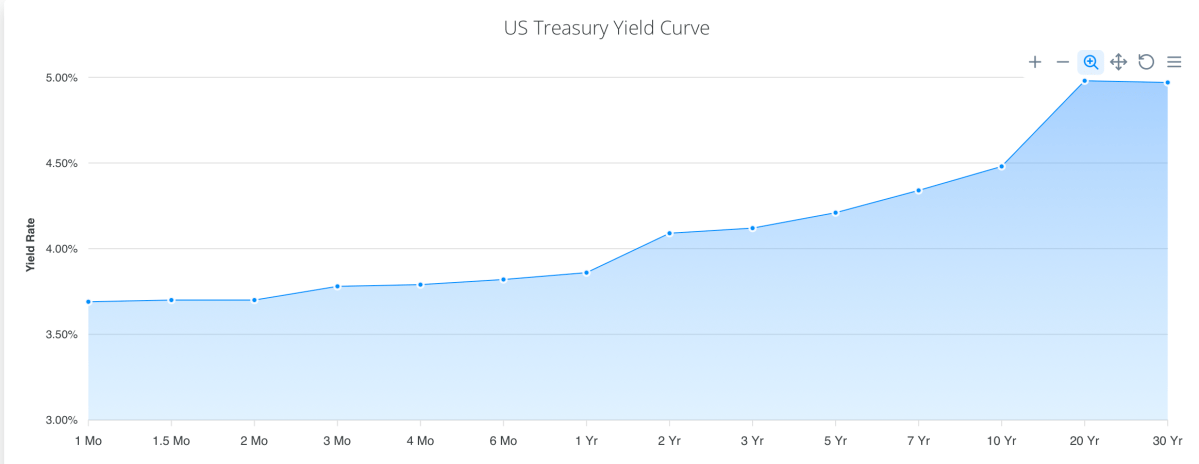
Meanwhile back in the USA, although the short term Fed funds futures market is predicting a hold, the longer term market is not as certain. The ten year Treasury is rising. The graph shows the Treasury yield curve for June 12, 2026. The sharp rise in long term Treasurys shows that the market is expecting the inflation to continue as long term Treasurys rise relative to short term Treasurys. One prominent economist is actually calling for an increase in rates at this month’s meeting. 

Fat chance! 

But when the Fed meets again July 28-29? Now that will be a closely watched meeting especially if inflation is not coming down. Indeed, CME’s FedWatch is now predicting that there is a 70 percent likelihood that the Fed will raise rates at its October meeting. All I can say to Kevin Warsh is BEWARE THE DONALD!!!

Red rabbits and the regressive progressives

The regressive progressives

“Hey, I only care about right-wing Nazis. Left-wing Nazis are okay in my book.” So says the “progressive” left — more accurately, the “regressive” left. I suppose I am old-fashioned, but would you actually want your senator to look like Graham Platner, who embodies the appearance of an axe murderer? Yes, I know — it’s that rugged outdoorsman look that supposedly personifies rural Maine. Never mind that it’s all an affectation from a prep school kid whose parents lent him $200,000 to buy a house he claimed was financed through the VA, and who calls himself an oyster farmer whose only client is his mother’s restaurant. It’s all for show.

What are Platner and his ilk actually for? Packing the court, ending the Electoral College, adding Puerto Rico and DC as states, abolishing ICE, open borders, cutting the military, raising the minimum wage, imposing rent controls and usury ceilings, taxing the rich, free daycare, free college, free universal single-payer healthcare, a government takeover of the means of production, ending right-to-work laws, legalizing abortion, more “gender-affirming” care, DEI, men in women’s sports, the Green New Deal, no nukes, a universal guaranteed income, reparations, higher corporate income taxes, defunding the police, globalizing the Intifada, free public transportation, more affordable housing, government grocery stores, caps on drug prices, social justice, no work requirements for government assistance, a living wage for all, ending mass incarceration, expanding gay rights, eliminating voter ID requirements, increased oversight of financial institutions, reducing income inequality, and increased regulatory oversight of industry — and whatever else I may have left out.

I have lost respect for my left-wing friends who refuse to disavow Platner. They try to throw Ken Paxton back at me — but I dislike Paxton, too. I feel sorry for the people of Texas who have to choose between Talarico and Paxton. Yet I have a particular contempt for those on the left who continue to support Platner over Susan Collins in order to flip the Senate at any cost. This is part of the far left’s effort to continue its takeover of the democratic party. In many cases, the progressives seek to oust the establishment democrat with someone on the far left who wants to literally blow up the economy and the country. Personally, if either Paxton or Platner were elected, I would hope that the Senate would have the guts not to seat either one.

As one of Platner’s defenders has put it: “The days of weak, apologetic Dems are over. Our Tea Party is here.” Progressives compare themselves to the Tea Party? That’s an insult to the Tea Party, which was pro-America, not anti-America. I would not want to live in the progressive version of America — and frankly, if their agenda were ever fully implemented, most progressives wouldn’t either. Interestingly, the base of this movement — though driven by communist ideology — is not what Marx envisioned. It is not “workers of the world, unite” but rather college-educated whites, most notably white women, who are its driving force, not the aggrieved union worker.

Red Rabbits

What is particularly disturbing, however, is the mobilization of a militant, Antifa-style cadre of trained agitators — the Red Rabbits, a name that is all too fitting. Note that they did not call themselves “blue”rabbits after the “red” state/ “blue” state nonesense. The Red Rabbits are the militant arm of the Democratic Socialists of America. The name stems from the Richard Adams’ novel Watership Down in which anthropomorphized rabbits escape the destruction of their warren and seek a place to establish a new home.

https://nypost.com/2026/06/09/opinion/socialist-red-rabbits-are-training-for-national-uprising-against-cops

The group wants the DSA to become a “revolutionary force” that will “prepare for a national uprising against federal agents and police brutality.” Whoa! Insurrection? It certainly sounds like it. The DSA and its “Liberation Caucus” are led in part by an avowed Maoist — internet personality Christopher Winston — who, like Platner supporter Cenk Uygur, has a long history of inflammatory rhetoric. The DSA is constructing a nationwide apparatus of disruption to support its protests against ICE and facilitate direct-action demonstrators. Recently, organizers from Minnesota, Oklahoma City, Philadelphia, Tucson, Austin, and Portland compared notes. Their training has included martial-arts sparring, evacuation planning, wound-packing, radio communications, the use of umbrellas and signs to shield participants from and obstruct “fascists,” and even chemical-exposure training, in which participants practiced being pepper-sprayed.

In New Jersey, “DSA’s immigrant justice working group has become a go-to security resource for immigrant organizations and Palestine affinity groups.” In Philadelphia, the Red Rabbits began with abortion clinic “defense” efforts before expanding to assist groups focused on everything from “immigrant justice” to “Palestinian solidarity.” That work has also drawn the DSA into closer alliance with other radical organizations. Tucson’s Red Rabbits, for example, work with the Party for Socialism and Liberation — a would-be revolutionary political party with close ties to the Communist Party of China. Portland DSA cited its collaboration with the National Lawyers Guild — a left-wing legal organization with historic ties to the Soviet Union — to provide know-your-rights trainings.

So if the DSA is the kook left of the progressives, the Red Rabbits are the kook left of the DSA. That growing militancy worries me much like the terrorist wing of any political group. One would expect that Trump’s Department of Justice, the IRS, and the FBI will be taking a much closer look at the DSA and their “Red Rabbits.”

Bernie loves Donald! Americans love old cars!

Bernie loves Donald! Americans love old cars!

Bernie loves Donald!

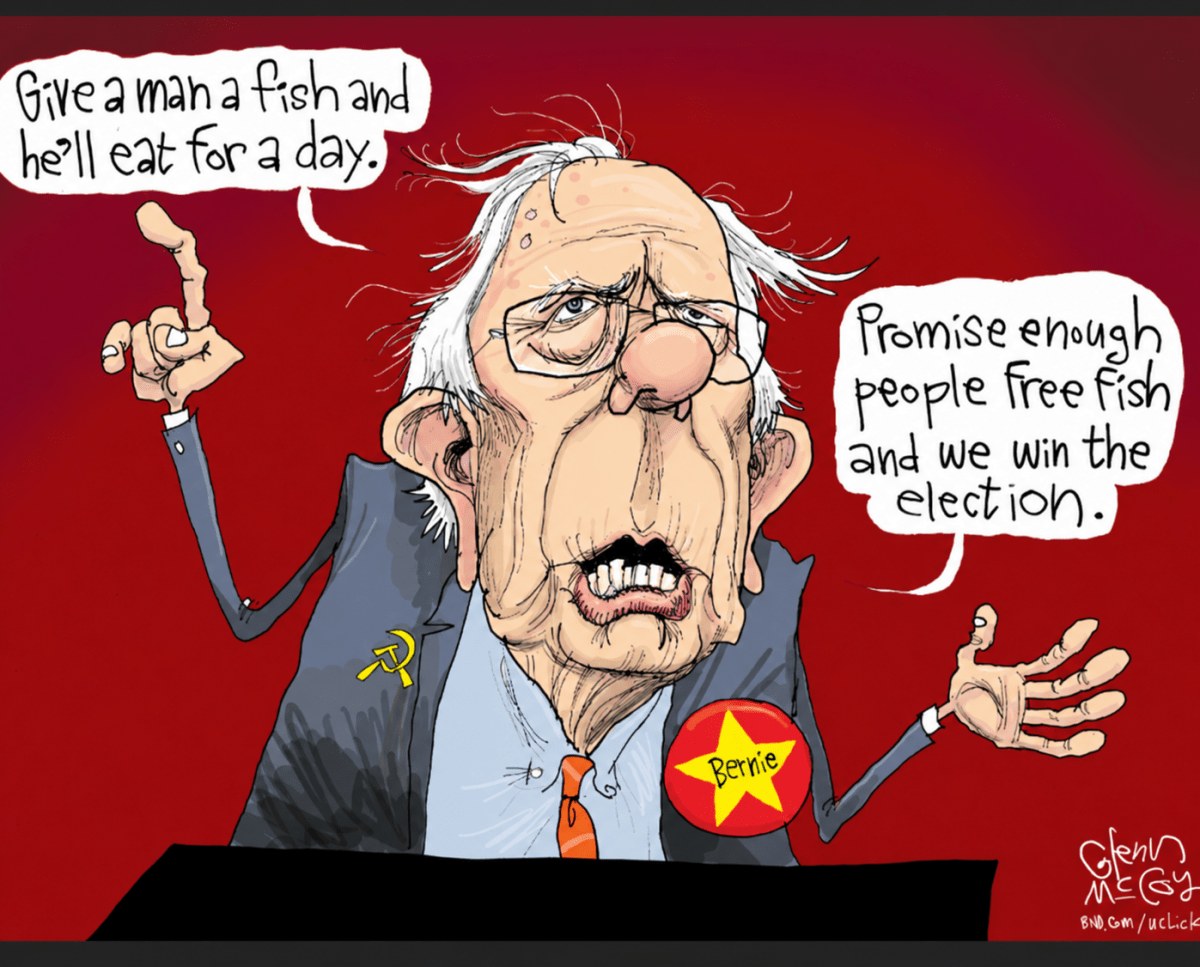
Someone once said that Republicans are like Democrats, only slightly less so. That description seems especially apt for Donald Trump, whose economic views would make Bernie Sanders proud —recalling the old Persuaders song, “It’s a Thin Line Between Love and Hate.” So what separates Bernie Sanders from Donald Trump? Mainly age: Sanders is 84, while Trump is a 80. Both favor using government power to seize private wealth. Bernie has proposed that the federal government take 50% of the stock of AI companies. Outrageous? His RINO ally DJ has floated a similar idea, promising to make Americans “rich as hell” by requiring AI companies to sell equity stakes to the federal government.

Sanders harks back on Obama’s “you didn’t produce that” and AOC’s contention that the wealth of some comes by making others worse off. Sanders justifies his expropriation by saying that AI was produced through the “collective knowledge of humanity”. Hey “Artificial intelligence was not created out of thin air. The data and language used by generative A.I. tools didn’t just pop into Sam Altman’s head or Elon Musk’s imagination. A.I. is built on our collective intelligence: our books, songs, artwork, journalism, computer code, scientific research, videos, conversations, images and ideas spanning generations.” By that logic, I should get a cut out of the profits of every producer of goods and services no matter how big or how small – including some of Bernie’s book royalties.

Now we will see if the republicans continue to genuflect to Trump. Ted Cruz says “I don’t think the federal government should be in the business of being an equity holder in private companies.” All well and good, but where was Cruz when Trump started this road to socialism by demanded a piece of other firms? Cruz was silent while the Trump government has taken equity stakes in private companies. In August 2025 it acquired 10 percent of Intel. As of mid-2026 the government had spent $30 billion in sixteen companies, mostly semiconductors and rare earths.

I guess it is a matter of semantics. Bernie being the good socialist that he is wants to expropriate the 50 percent stake in AI while Trump is purchasing his government share with the government’s money. But any way you slice it, both are big government socialists at heart.

We love old cars

You know you are old when your car has a cassette player. Actually my CLK 350 does have a cassette player but the F250 and the GLS 450 have CD players. Do new cars have CD players? My CLK is a 2007. The F250 is a 2017 while the GLS is a 2018. I am in equilibrium and have no desire for a new vehicle. As a matter of fact, I would not trade any of my vehicles for a new one. The CLK is my favorite Mercedes convertible and I actually pat it when I put it up for the night. When my GLS was in the shop and they give me a loaner, I like the technology in the new ones but they just feel cheap. My GLS has higher end seats and fixtures than the new models. It feels more solid too. I would rather have mine than a new one. The F250 has 165,000 miles on it and is the best truck I have ever owned. It has towed a 41 foot toyhauler all over the east coast and to motorcycle rallies way up north and out west. We camp with it when we visit out of state friends and the fifth wheel makes a great hunting lodge. It is also my farm truck and I will drive it – and the others – until the wheels fall off.

I am not by myself. Americans are keeping their vehicles longer. We are not quite the Cubans but the average American car is 12.6 years old. Insurance costs – I changed companies because my old one tried to lowball me on the repairs when a deer attacked my GLS 450 – and especially the ridiculous high prices of new cars are enough to keep the old clunkers going. I am old enough to have paid $1,650 for a new Toyota Corolla in 1968. Even on a graduate student’s stipend I could afford it. Now a Toyota Corolla starts at $30,000 and goes to over $40,000. 

Those factors also mean that the number of new cars purchased yearly in America have fallen by one million units. So more and more Americans are opting to keep their cars longer. You would think that the auto dealers who get half of their revenues from their service shops would benefit. But customers have increased doing it yourself and have also gone to independent repair shops resulting in dealer service visits falling by 12 percent last year. 

I haven’t done the math but it is likely that the American automobile manufacturers would rather make SUVs and pickups that are more expensive with higher markups than small sedans increasing overall profitability. No American manufactured cars are under $30,000. Since that is the case, then your government should remove all tariffs on vehicles imported into the country with a list price under $30,000 and leave that market to the Japanese, Koreans and Chinese. I am tempted to say that the Asians build small cars because they are small people – but I won’t.

Mike Pence versus the Cult of Trump

Mike Pence versus the Cult of Trump

Mike Pence

I have a genuine respect for Mike Pence. While many of those around him abandoned their conservative principles in favor of Trump’s brand of populism, Pence has largely held his ground. His essay “A Republican Time for Choosing,” published in the Wall Street Journal, clearly articulates those principles.

Much of what Pence writes echoes concerns I have raised since Trump first took office — including my recurring unease about the stranglehold our two-party system has on American politics. I won’t rehash those arguments here. But one passage in Pence’s essay deserves particular attention: his invocation of Calvin Coolidge’s 1926 speech in Philadelphia, delivered on the 150th anniversary of the signing of the Declaration of Independence.

“If all men are created equal, that is final. If they are endowed with inalienable rights, that is final. If governments derive their just power from the consent of the governed, that is final. No advance, no progress can be made beyond these propositions. If anyone wishes to deny their truth and their soundness, the only direction in which he can proceed historically is not forward, but backward toward the time when there was no equality, no rights of the individual, no rule of the people. Those who wish to proceed in that direction cannot lay claim to progress. They are reactionary.”

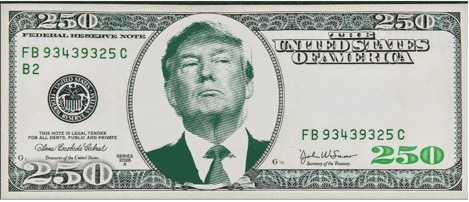
Against that backdrop, consider how Trump has chosen to mark the 250th anniversary of the nation’s founding. A $250 bill bearing his likeness? A proposed “settlement” funneling $1.776 billion in taxpayer money to political allies — since blocked by a federal judge? The plastering of his name across Washington landmarks, including the Kennedy Center, where another federal court has ordered its removal? And then there is the spectacle of the National Mall celebration, where Trump announced himself as the headline act after a string of performers — Martina McBride, Bret Michaels, Young MC, Morris Day and The Time, and The Commodores — declined to participate. Trump dismissed them as “overpriced singers, who nobody wants to hear, whose music is boring,” and declared on social media that he was bringing “the man who some say is the Greatest President in History (THE GOAT!), DONALD J. TRUMP” to take the place of these highly paid, Third Rate ‘Artists.’” 

But of course everyone wants to hear a two hour speech by the president!

The Cult of Trump

As Pence observes, Trump’s populism has gradually transformed his movement from a conservative coalition into something more closely resembling a personality cult. The phenomenon is not unique to Trump — it follows the familiar logic of any cult organized around a single charismatic figure. Those who once identified as principled conservatives have, in many cases, jettisoned those principles entirely, endorsing behavior from Trump that they would roundly condemn in any liberal politician.

The conflicts of interest alone should give pause. Trump purchased $5 million in Dell shares, after which Dell was awarded a $9 billion government contract. To MAGA loyalists, this registers as unremarkable. George Will — hardly a Trump sympathizer — put it bluntly: the GOP has “become a cult” whose beliefs are whatever its leader declares, even when those declarations contradict longstanding conservative orthodoxy. As Will noted, Trump’s Republicans have found themselves in agreement with progressive Democrats that the government should be directing the economy — rejecting free trade for protectionism and free markets for state intervention. That his supporters can absorb these contradictions and still find their footing is, at minimum, a feat of considerable cognitive flexibility.

Again TDS reigns on both sides.

What we have, in practice, is whim-driven governance — mercurial, unpredictable, and largely untethered from coherent principle. The tariff policy offers the clearest illustration. The rationale shifts constantly; the targets seem almost random. Allies and adversaries are treated interchangeably. Trade surpluses and deficits seem equally irrelevant. The policy reaches its logical nadir when the president raises tariffs on Switzerland, reportedly because he took offense at the Swiss president’s tone during a phone call.

Recall that Trump told Fox’s Bret Baier, before taking office, that he would be too busy governing to pursue retribution against his enemies. I wrote at the time that this was a lie — a claim that cost me my column at the Knoxville Focus, a local “conservative” weekly. The subsequent record has vindicated the assessment. The Department of Justice has functioned, in no small part, as a Department of Retribution, pursuing more than 48 individuals Trump regards as adversaries — among them E. Jean Carroll, who accused him of sexual assault in the 1990s. The case of John Bolton is particularly instructive: forced into a “settlement” that required him to plead to a felony charge for conduct that, in prior cases involving more serious offenses, had drawn only misdemeanor treatment. That prosecutors continue to push for jail time suggests motivations that are, at best, difficult to distinguish from pure vindictiveness. Bolton, for his part, should have had the judgment to wait until Trump left office before publishing his memoir.

I have long argued that Trump Derangement Syndrome cuts in both directions. His opponents are consumed by a reflexive hostility that distorts their judgment; his supporters are consumed by a reflexive loyalty that does the same. Both are, in their way, cults — one organized around loathing, the other around devotion. Neither is a reliable guide to the truth.

The Democrats’ Recruitment Class: When the Fringe Becomes the Face

The Democrats’ Recruitment Class: When the Fringe Becomes the Face

There is a rule in politics that used to be bipartisan common sense: the candidates you recruit say everything about what your party stands for. By that standard, the modern democratic party has a serious problem — and it is one entirely of its own making. Across the country, democratic primaries are producing candidates whose views would have been disqualifying in any serious political organization a decade ago. The party that once prided itself on pragmatic governance and broad-tent coalition-building has instead become a proving ground for ideological maximalism — rewarding candidates who compete to see how far left they can sprint before falling off the edge.

The Progressive Surge

The progressive wing of the democratic party has convinced itself that the path to power runs through ideological purity. The result is a candidate pipeline that prioritizes litmus tests over electability and grievance over governance. Calls to abolish prisons, seize private industries, and dismantle America’s international alliances are no longer fringe positions whispered at activist meetings — they are campaign platforms, endorsed and celebrated.

What’s striking is not just the radicalism of some of these positions — it’s the institutional cowardice with which the democratic establishment has responded to them. Party leaders who once would have drawn clear lines have instead hedged, equivocated, or quietly looked the other way. The result is a party that cannot define what it stands for, because it is too afraid of the activists who fund and organize it to say no to anyone.

Character No Longer Counts

Beyond ideology, there is the matter of basic character standards — once considered a floor, not a ceiling, for public office. Democrats spent years insisting that personal conduct mattered, that who a candidate was as a person reflected on the party and ultimately on governance itself. That standard has now been selectively abandoned whenever inconvenient. Serious questions about a candidate’s character are brushed aside as distractions the moment ideological allies decide an election is too important to lose.

This is not a matter of partisan scoring. It is a coherent observation: a party that refuses to enforce its own stated values is a party that has no values — only interests. Voters notice.

The Antisemitism Problem

Perhaps most glaring example has been the democratic Party’s halting, inconsistent response to antisemitism within its own ranks. Jewish voters — a constituency that has been reliably democratic for generations — are watching candidates who traffic in anti-Jewish rhetoric receive enthusiastic support from prominent party figures. The double standard is glaring – rhetoric that would end a republican’s career overnight is tolerated, rationalized, or ignored entirely when it comes from the left.

Republicans have a genuine opportunity here — not to exploit fear, but to offer something the democratic party currently cannot: a clear, unambiguous commitment that antisemitism has no home in American politics, period, regardless of which side of the aisle it comes from. Jewish Americans deserve a political home where their safety and dignity are not conditional on their ideological alignment.

What This Means for 2026 and Beyond

Democratic recruitment is not merely an internal party management problem. It is a window into the soul of an institution in ideological free fall. A party that cannot say no to its most extreme voices, that cannot enforce basic standards of conduct, and that cannot protect its own most loyal constituencies from harassment and hate is not a party fit to govern.

Republicans should resist the temptation to simply mock and move on. The better choice is to contrast — clearly, repeatedly, and specifically — what principled governance looks like against what the democrats are currently offering. Voters in competitive districts are not ideologues. They want competence, stability, and leaders who can pass a basic integrity test.

The democrats are making the argument for republicans. The task is simply not to get in their way.

MAGA too!

And yes, I am not giving the republicans a pass. Just go back and read previous postings. Recall, I got fired from the local “conservative” weekly for not being 100 percent MAGA and having the audacity to be critical of our (RINO) president. The republicans have their MAGA fringe led by the occupant in the White House. There are Andrew Clyde, Randy Fine, Andy Ogles, Tim Burchett and some of the 40 member Freedom Caucus. But the MAGA fringe is a personality driven cult. It does not have legs and will end when Trump leaves office. But no single personality drives the fringe on the left. It is a collection of souls that seems to grow daily. From the vacuousness of AOC to the toxicity of Graham Platner, the progressive left appears to have more staying power than the MAGA right. Consider that the far left progressive caucus in the House sports 97 members while its “center-left” New Democrat Coalition has 110 members (30 of whom also belong to the progressive caucus. So 177 of the 212 democrat members of the House are either center-left or fringe left. That, my friends, is not a personality driven cult like the MAGA-folk and why it is here to stay for a while.

Costco emulates China!

Costco emulates China!

Is China cheating in world markets?

The OECD recently reported that 60 percent of China’s market-share gains across 15 industrial sectors were driven by government subsidies with Chinese firms receiving three to eight times more state support than their domestic competitors. The implications are threefold. First, those subsidies allow Chinese companies to undercut foreign rivals on price, sometimes selling below cost. Second, this practice is a key reason the Chinese economy is under serious strain. One has to wonder how long Beijing is willing to bleed its own finances to capture global market share. Third, Western consumers benefit at Chinese citizens’ expense. We buy goods below market price while ordinary Chinese people foot the bill.

Source: OECD Finds 60% of Chinese Gains in Market Share Driven by Subsidies

It may surprise you but I support tariffs on subsidized imports set equal to the value of the subsidy, not as protectionism, but as a corrective measure to level the playing field. My preference remains zero tariffs and zero subsidies across the board. The United States is hardly blameless here. Washington heavily subsidizes agriculture and provides substantial support to aerospace, energy, and manufacturing, totaling roughly $150 billion annually. A more productive approach would be negotiating mutual agreements to eliminate export subsidies altogether.

Do you Costco?

Which brings me to Costco. Have you noticed the gas lines? I pay $65 a year for membership for the privilege of making Costco my primary gas station. It is closer than Sam’s, is conveniently located and is 30 to 50 cents per gallon cheaper than other gas stations. That kind of pricing is classic loss-leader strategy. Costco acknowledges that members who buy gas are more likely to shop inside, generating revenue that offsets the below-market fuel prices. In other words, Costco is doing exactly what critics accuse the Chinese of doing, using subsidized pricing in one category to gain broader market advantage. Should Costco be penalized for it? If not, the logic of sanctioning China for doing the same thing subsidies deserves a harder look.

On a more personal note, I have never loved shopping at Costco. The parking lot is perpetually packed with the carts piled high as though a storm is coming. The Costco app is useless as are the employees. No one who works there knows where anything is. Also, Costco must pay Apple News, because every day there are articles about shopping at Costco. I don’t think a single item in any of the articles is healthy and not a single one I would buy.

Honestly, I hate Costco. I hate the crowds. I hate the lousy service. Despite the convenience, I am going to go to let my membership expire and buy my gas at Sam’s. I prefer Sam’s anyway. The checkout is faster. The stuff I buy is cheaper at Sam’s. And the clerks don’t have nose rings and assorted facial piercings – except for an occasional nose stud (what’s with these nose piercings anyway?). Also I only buy two things at Costco, their coastal cheddar cheese and their Kirkland brand salsa. Well, the salsa is now gone – slated for deletion (because of course, I buy it). I am therefore not renewing and will buy the bulk cheese at Sam’s, while not as flavorful, it’ll do.

So has Costco adopted the Chinese economic playbook of using subsidized pricing in fuel to erode competition from independent gas stations? It comes as no surprise that it has opened stores in Shanghai and Shenzhen. I wonder if gas is a lost leader there as well? Perhaps the saving grace for small businesses here may be the very things that frustrate Costco shoppers –  the membership fee and the interminable lines act as natural barriers that keep bulk retail from completely displacing neighborhood stores. At least for now.

Hegseth at Normandy

Hegseth at Normandy

Pete (Fox News) Hegseth gave a speech at the 82nd anniversary of D-Day. As I have often mentioned, my other half’s father was a Bedford Boy and was in the first waves at Omaha Beach. So I was especially interested in Hegseth’s remarks – given that he is my least favorite of Trump’s cabinet. Well his speech was covered very differently by the media. While it was reported in glowing patriotic terms by the rightwing press, such was not the case with the European media. In fact, it stirred up a hornet’s nest on the continent a fact ignored by Trump’s news outlets here.

Hegseth took the occasion to criticize European nations over illegal migration for allowing what he described as an “invasion” on their shores during the speech. The Europeans had a proverbial cow and did not report any other part of his speech. Hegseth said “Sadly, today, different European beaches are stormed by different dangerous ideologies. Beaches in Spain, in Italy, in Greece and Bulgaria. Boats and men arrive. When will European capitals do something about that invasion?” Hegseth said that in the years since D-Day some European capitals have grown too “comfortable” with their hard-fought freedoms, forgetting that “freedom is not free”. “The men who fought and died here restored freedom to Europe. That freedom must be maintained by this generation of leaders and war fighters or what they fought for was merely temporary.”

The European press was not pleased. The Guardian reported that Hegseth was accused by European historians of “grotesque stupidity” and desecrating the memory of the soldiers who stormed the beaches of Normandy after he sought to link immigration to the D-day anniversary, saying Europe was facing a different “invasion” of its shores.” https://www.theguardian.com/world/2026/jun/07/pete-hegseth-d-day-speech-immigration-grotesque-stupidity

The British historian Simon Schama described the remarks as a “special kind of loathsomeness: a blend of historical deafness, grotesque stupidity and comically ludicrous self-importance”. “As if the little people’s rage against immigration somehow is superior to the war against the 3rd Reich and entitles this comic book nobody to lecture the actual heroes.” [Don’t you love the command of the English language by the English?}

Here are more comments from the Guardian. Israeli lawyer Daniel Seidemann said “This is an obscene desecration of the memories of those who

stormed the beaches of Normandy, and especially of those who fell.” Anders Åslund, a Swedish economist contrasted the comments with Hegseth’s later remarks on the US standing alongside its allies. “So much nonsense,” he wrote on social media. “‘We stand by our allies!’ No you don’t. You just attacked them. Immigration policies are internal matters.” Åslund said Hegseth’s comments were particularly “clueless” given his recent decision to skip a key NATO meeting and Donald Trump’s vows to cut the number of troops in Europe. “Doesn’t Hegseth know that the most unreliable ‘ally’ by far is the US?” 

This reporting is in stark contrast to the coverage of the event by the Trump mouthpiece Red State where never a word of criticism of anything Trump or Trump related is printed. This publication is as biased as anything on the left. You can read it for yourself. The is no mention of Hegseth’s remarks on immigration. “Hegseth Remembers Those Who Fought During 82nd D-Day Commemoration at Normandy”

https://redstate.com/nick-arama/2026/06/06/hegseth-marks-d-day-anniversary-n2203110

Also, it is apparent that Hegseth decided to go off script and join others in the administration (JD Vance) at lecturing the Europeans on their own soil because the official remarks from the Department of Defense made no mention of illegal immigration. So I guess Red State only looked at the official release from the Department of Defense and did not actually cover the event itself. You may read the speech at https://www.war.gov/News/Speeches/Speech/Article/4208765/remarks-by-secretary-of-defense-pete-hegseth-at-the-81st-d-day-landings-anniver/

Here are the last two paragraphs.

“Our world is a better place when Europe and America are strong, free, and independent. France understands this well and so do the men buried here, and so do the men sitting before me. Our nations together have endured a bond intertwined by history and we share this hallowed ground underneath our feet dedicated and consecrated by the blood of our heroes.

Our moment today is an echo. It’s an echo of theirs and may we live worthy of them. It is truly one of the honors of a lifetime to commemorate the sacrifices of D-Day and celebrate the freedoms of our two nations. God bless you all and may God bless our warriors. Thank you.”

It’s about time! Gerrymander scorecard.

It’s about time! Gerrymander scorecard.

It’s About Time!

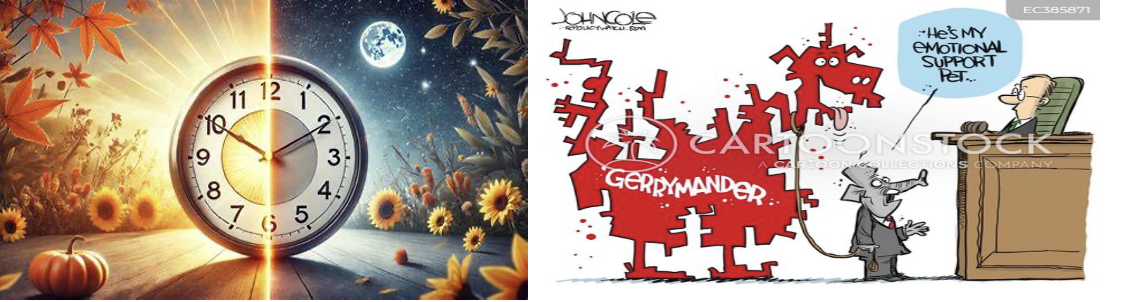
How do you feel about changing the clocks — springing forward and falling back? I personally hate it. It takes both me and my dog a while to adjust. Since I get up around 5:30 a.m. seven days a week, my German Shorthaired Pointer, Lili, needs time to reset her internal clock as well. Depending on which way we’ve sprung or fallen, she’ll want to be walked and fed at either 4:30 a.m. or 6:30 a.m.

I’ve reported before that the Georgia legislature voted to move to Atlantic (Bermuda) time year-round. Now, the House Energy and Commerce Committee has voted 48–1 to make Daylight Saving Time permanent.

The president was ecstatic, tweeting: “Big Vote today (48–1!) in the Energy and Commerce Committee on a Bill including The Sunshine Protection Act, which will make Daylight Saving Time Permanent! This is so important — hundreds of millions of dollars are spent every year by people, cities, and states being forced to change their clocks. Many of these clocks are located in towers, and the cost of renting or using heavy equipment to do this twice a year is prohibitive! It’s time that people can stop worrying about the clock, not to mention all the work and money spent on this ridiculous, twice-yearly production. It will also be a very nice win for the Republican Party. We are going with the far more popular alternative — saving daylight — which gives you a longer, brighter day. And who can be against that? This is an easy one! The House and Senate should push hard for more daylight at the end of the day. Very popular and, most importantly, no more changing of the clocks — a big inconvenience and, for our government, a very costly event!”

I think he left out the confusion it causes for hens trying to lay their eggs on schedule — and for dairy cows wondering when it’s time to be milked.

My clocks reset automatically, so I’ve had my own run-in with time changes. I remember waking up one morning to go deer hunting and completely forgetting about the time change. I got up, walked the dog, and headed out to my tree stand — only to be puzzled by how long it was taking for sunrise. When I checked my watch (which I only wear when hunting), it read 4:30 a.m. instead of 5:30. I’m fairly certain that was the longest hour of my life. The deer seemed confused too — nothing was stirring that morning.

Who Gained, Who Lost in the Latest Gerrymandering Wars?

I’ve written before about “safe” seats versus “competitive” House seats. Most seats in the House are safe, and the purpose of gerrymandering is to make even more of them that way. California sought more safe Democratic seats. Texas aimed for more safe Republican seats — and specifically tried to eliminate the seats held by Jasmine Crockett and Al Green. Tennessee worked to dismantle the safe Democratic seat in Memphis, much as it previously did with the one in Nashville, converting both into safe Republican seats.

So when all is said and done, which party came out ahead? Karl Rove has weighed in on the question. (See: Gerrymandering Isn’t Enough for the GOP — WSJ)

Rove finds there are 184 safe Democratic seats, 188 safe Republican seats, and only 63 competitive ones — 18 of which are considered toss-ups. To maintain control of the House, Republicans must win 30 of those 63 competitive seats. Democrats need 34 to regain control and install Hakeem Jeffries as Speaker.

In a typical off-year election, the president’s party loses around 30 seats. But this is far from a typical election. When Obama’s approval rating dropped to 45 percent, Democrats lost 63 seats. With Trump’s approval now below 40 percent, it would be remarkable if Republicans managed to hold the House. However, gerrymandering makes it nearly impossible for them to lose 63 or more seats.

Brace yourself: Hakeem Jeffries as Speaker, Democrats in control of all House committees, and impeachment — part three.